
Roofing service
Storm Damage Roof Repair in Orange Park, FL
After wind and heavy rain, the damage that matters is often the damage you cannot see from the ground.
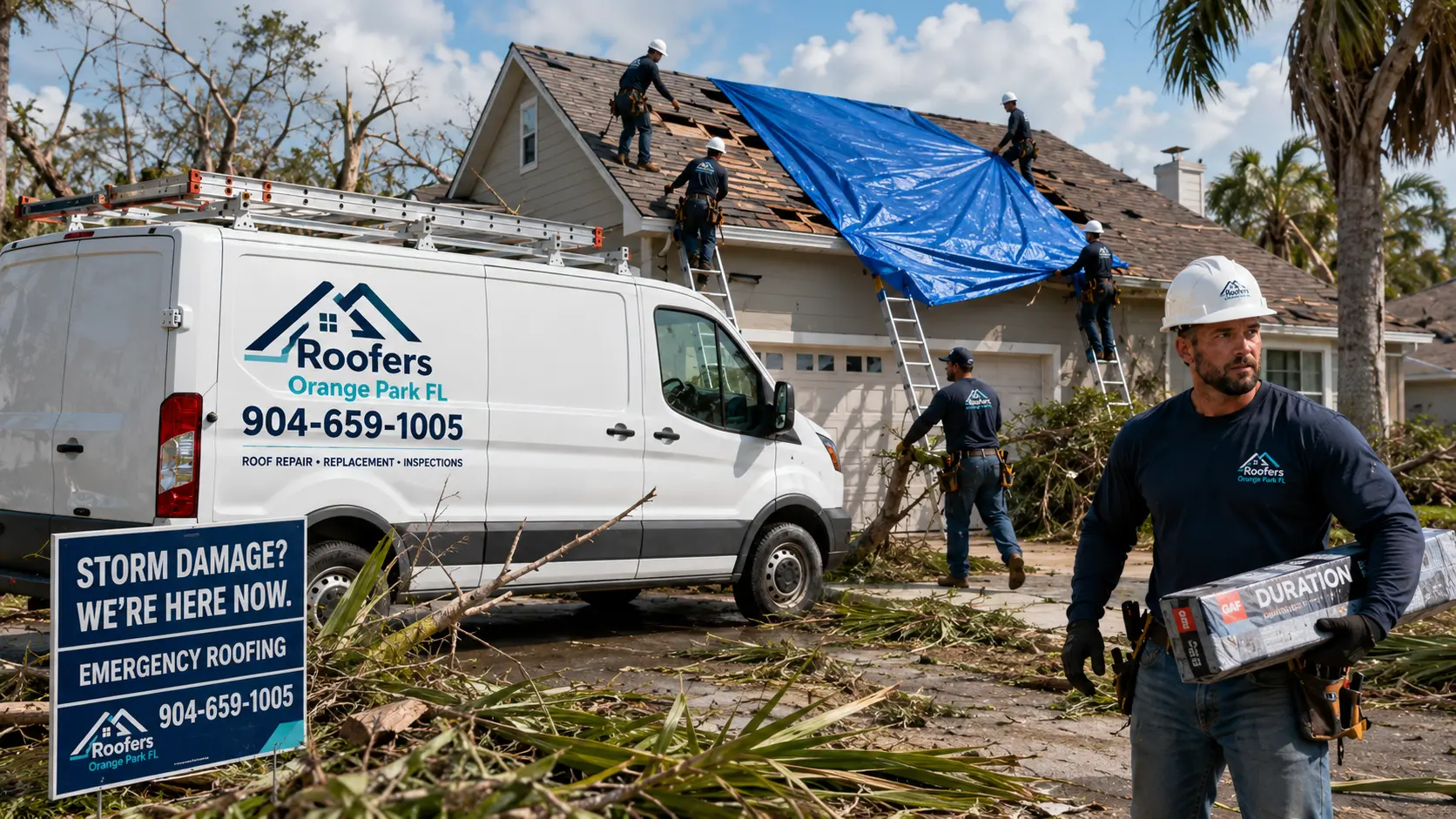
Northeast Florida gets storms in two flavors: the routine summer afternoon thunderstorm season, and the occasional tropical system that produces sustained high wind over hours. Both damage roofs, but they do it differently and the damage looks different afterward.
The most important thing to understand about storm damage is that visible loss is only part of it. A roof can lose no shingles at all and still have dozens of them whose seal strips broke, leaving the roof functionally compromised the next time wind arrives. That is why post-storm evaluation is worth doing even when the roof looks intact from the driveway.
Roofers Orange Park FL inspects and repairs storm-related roofing damage throughout Orange Park, communities throughout Clay County, and nearby Southwest Jacksonville. Call 904-659-1005 to describe what happened.
What wind actually does to a roof
Wind does not simply push on a roof. Air moving over the surface creates negative pressure — uplift — that pulls upward, and that pressure is dramatically higher at edges, corners, rakes and ridges than in the middle of a roof plane.
That is why storm damage almost always starts at a perimeter. Once wind gets under one shingle at an edge, it has leverage on the course above it, and damage propagates inward. Metal panel roofs behave similarly: perimeter attachment is where uplift resistance is won or lost.
- Shingles fully removed, leaving underlayment or decking exposed.
- Shingles lifted and reseated but no longer sealed — invisible from the ground, functionally open.
- Creased shingles, where the shingle folded back and cracked at the fold even though it returned to position.
- Displaced or missing ridge and hip caps.
- Torn or bent flashing at walls, chimneys and roof transitions.
- Damaged or dislodged vents, pipe boots and exhaust caps.
- Impact damage from falling branches or wind-blown debris.
- Gutter and fascia damage that affects how water leaves the roof.
Water intrusion after a storm
Water that got in during a storm does not necessarily announce itself immediately. Insulation absorbs and holds moisture, and a stain can take a day or more to develop on a ceiling. Signs to watch for in the days after a storm include new ceiling or wall discoloration, a musty smell in a closet or attic, bubbling paint, or damp insulation.
If you can safely access the attic, looking at the underside of the decking with a flashlight during or shortly after rainfall is one of the most informative things a homeowner can do. Dark, wet sheathing or active dripping tells you a lot about location.
Temporary mitigation
When a roof has open damage and more rain is coming, temporary protection limits how much water enters the building while a permanent repair is planned and scheduled. Tarping is the common approach — securing a covering over the damaged area to shed water until the repair can be done properly.
Temporary mitigation is exactly that: temporary. It buys time and reduces interior damage. It is not a repair and should not be treated as a long-term condition. Materials degrade in Florida sun quickly.
We will discuss what is realistic for your situation and timeline when you call. We do not advertise a guaranteed response window we cannot commit to for every property.
Documenting the damage
Good documentation helps regardless of what you do next. Photograph the property before anyone climbs on the roof if it is safe to do so, capture interior damage as it appears, note the date of the storm event, and keep any communications and estimates organized.
Our inspection produces written findings and photographs of the conditions we observe. That record is useful whether you are proceeding with a repair directly, comparing contractors, or working through a claim with your insurer.
About insurance — informational only
Many Florida property owners will consider whether storm damage is covered by their policy. Coverage, deductibles, exclusions and claim procedures are set by your insurance policy and your insurer, not by a roofing contractor.
We can inspect and document the roof's physical condition and provide a written repair or replacement scope. We cannot tell you whether your claim will be approved, and we will not promise that it will be. We are not public adjusters and do not act as your representative in a claim.
Be cautious with anyone who knocks on your door after a storm promising a free roof or guaranteeing insurance coverage. Those promises are not theirs to make.
Repair or replacement after a storm
Storm damage confined to one slope, one edge or a limited number of shingles on a roof that was otherwise in good condition is a repair. That is the common case after a typical thunderstorm.
Replacement becomes the appropriate conversation when damage crosses multiple slopes, when a large percentage of shingles have broken seals, when the roof was already near the end of its service life before the storm, or when decking has been compromised.
We assess and tell you which situation you are in. We do not convert every storm call into a replacement pitch.
Reducing exposure before the next storm
- Have the roof evaluated periodically so small failures are corrected before wind can exploit them.
- Keep trees trimmed back from the roof so limbs cannot flail against or fall onto the surface.
- Keep gutters and drains clear so water leaves the roof efficiently during heavy rainfall.
- Address loose flashing, lifted shingles and aged pipe boots when they are found, not later.
- Make sure attic ventilation openings are intact and functioning.
- Photograph your roof and property while everything is in good condition so you have a baseline.
Storm Damage Roof Repair questions
Should I have my roof checked after a major storm even if nothing looks wrong?
Yes, it is worthwhile. The most consequential storm damage — shingles whose seals have broken but which are still lying flat — is invisible from the ground. Finding it before the next storm is much better than discovering it when the shingles leave the roof.
What should I do first after wind damages my roof?
Make sure everyone is safe and stay off the roof. Photograph what you can see safely from the ground and any interior damage. If water is entering, move or cover belongings and contain the water. Then call a roofing contractor — 904-659-1005 — and describe the situation.
Will my insurance cover storm damage to my roof?
That depends entirely on your policy, your deductible, the cause and date of the damage and your insurer's determination. We can document the physical condition of the roof and provide a written scope. We cannot and will not tell you a claim will be approved.
How long can a tarp stay on my roof?
Temporary coverings are meant to limit water intrusion for a short period until a permanent repair is completed. Florida sun and wind degrade tarps quickly, and a tarp left indefinitely will eventually fail and may cause additional damage where it is fastened.
Can you tell whether damage came from a specific storm?
We can describe what we observe — creased shingles, broken seals, impact marks, displaced material — and note conditions consistent with recent wind or impact events. Attributing damage to one specific date is a determination we do not make on your behalf.
Someone knocked on my door offering a free roof after the storm. Is that legitimate?
Be careful. A contractor cannot know your policy terms or guarantee an insurer's decision, and offers to cover or waive a deductible raise legal concerns in Florida. Get written scopes, verify who you are dealing with, and do not sign anything you have not read.
Do you handle both the repair and the interior damage?
We handle the roofing side — stopping the source and repairing or replacing the roof system. Interior restoration such as drywall, ceiling and flooring work is a separate trade, and we will be clear about where our scope ends.
Related roofing services
Where we provide this service
Storm Damage Roof Repair is available across Orange Park, communities throughout Clay County, and nearby Southwest Jacksonville, including Orange Park, Fleming Island, Middleburg, Green Cove Springs, Oakleaf Plantation, Lakeside, Bellair-Meadowbrook Terrace, Doctors Inlet, Asbury Lake, Argyle Forest, Eagle Harbor, Pace Island. See all service areas.
Ready to get your roof looked at?
Call 904-659-1005 or request an estimate and describe what your roof is doing.