
Local roofing help in Orange Park
Roofers Orange Park FL
Residential roof replacement, new installation, and shingle and metal roofing for Orange Park and communities throughout Clay County and nearby Southwest Jacksonville.
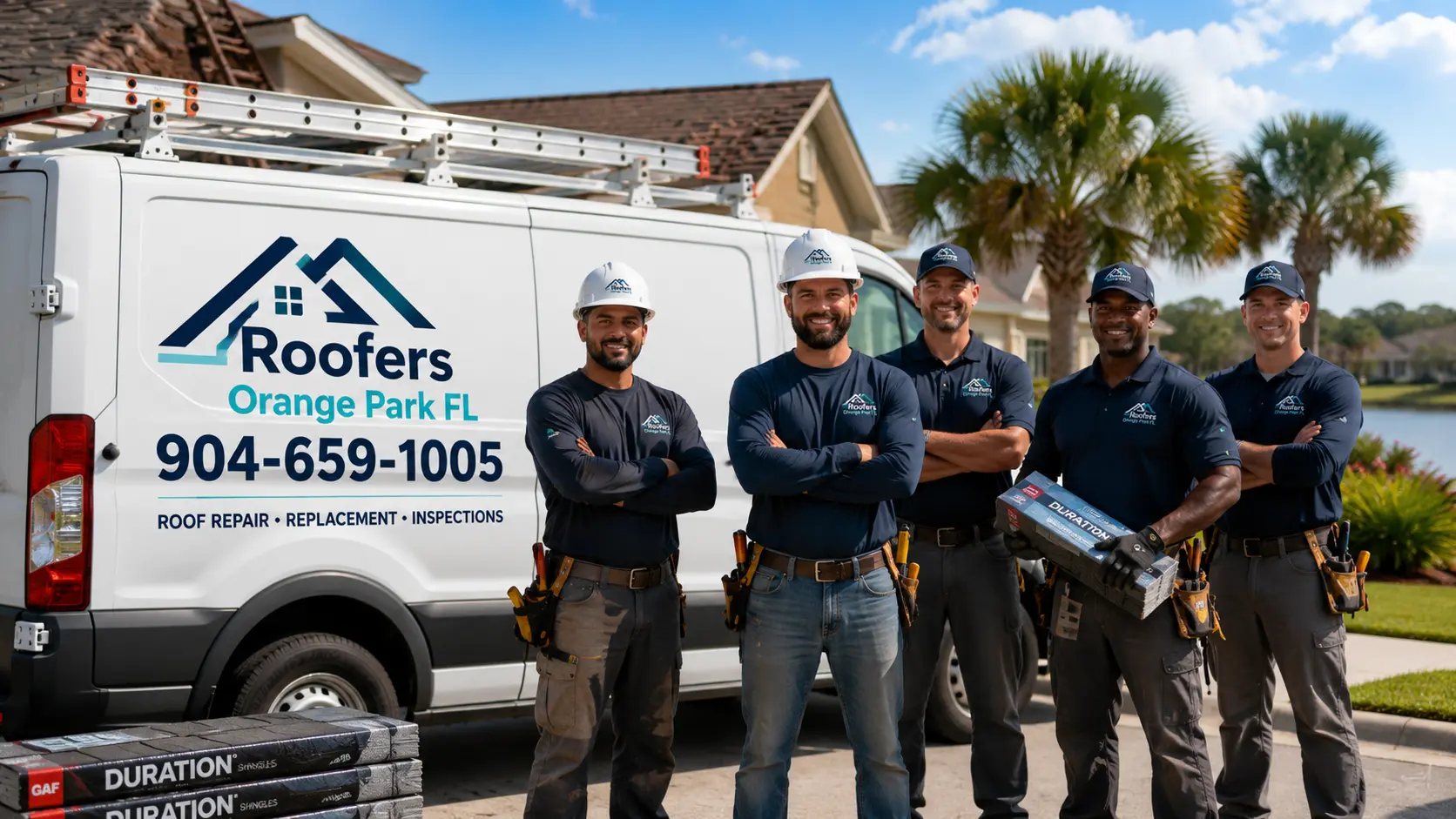
- Local Orange Park focus
- Residential roofing only
- Clear roofing recommendations
- Free estimate requests
Roofing for Orange Park homes
A roof in Northeast Florida works harder than most people realize. Sustained summer heat drives the volatile components out of asphalt shingles, near-daily storms test every flashing and penetration, humidity keeps organic debris damp on shaded slopes, and tropical systems push rain sideways under materials designed to shed it downward. Roofers Orange Park FL works with that reality every day, across Orange Park, communities throughout Clay County, and nearby Southwest Jacksonville.
We focus on residential roofing: roof replacement, new roof installation, shingle and metal systems, storm damage evaluation and roof inspections. Whether you noticed a ceiling stain after a storm, have shingles lifting near a rake edge, or are wondering how much life your roof has left, the process starts the same way: understand the actual condition of the roof before recommending anything.
Our contact address is 550 Wells Rd Suite 479, Orange Park, FL 32073. Roofers Orange Park FL serves Orange Park, communities throughout Clay County, and nearby Southwest Jacksonville — call 904-659-1005 to describe what your roof is doing.
Our roofing services
Roofing Cost Calculator Orange Park FL
Use this calculator to get a rough planning range based on the type of roofing project, approximate roof size, material, condition, and complexity. It is a budgeting tool for homeowners planning a roof replacement cost Orange Park FL budget — not a quote.
What Affects Roofing Cost in Orange Park?
Two roofs of the same square footage can price very differently, which is why any roofing cost Orange Park FL figure you find online is only a starting point. These are the variables that actually move a roofing estimate Orange Park FL homeowners receive after an on-site measurement:
- Project type — a partial-scope reroof, storm restoration work and a full tear-off replacement sit at completely different price levels.
- Roof size — pricing is driven by roof squares (100 sq ft of roof surface), not by the home's floor plan alone.
- Roofing material — architectural asphalt shingle is the value baseline; metal, tile and low-slope membrane systems cost more per square.
- Roof pitch — steeper slopes slow production and require additional fall protection.
- Number of stories — two and three-story homes add staging, ladder work and material handling time.
- Roof complexity — valleys, dormers, skylights, chimneys and multiple rooflines add flashing detail and labor.
- Tear-off — removing existing layers, disposal fees and dumpster placement are real line items on a replacement.
- Decking replacement — rotten or delaminated sheathing is only discovered once the roof is opened up and is priced per sheet.
- Flashing — chimneys, roof-to-wall transitions and valleys often need new metal rather than reused metal.
- Storm damage — wind and wind-driven rain damage frequently extends past the visible area and widens scope.
- Timing — urgent, fast-tracked projects carry a premium over work scheduled in advance.
- Access — tight lots, landscaping, fencing, pools and limited driveway space affect staging and cleanup time.
For real numbers on your roof, compare the two paths directly: residential roofing Orange Park FL · roof replacement Orange Park FL · asphalt shingle roofing · metal roofing · free estimate
Should I Repair or Replace My Roof?
Answer a few questions about the roof's age, damage, leaks, and repair history to see which next step may make the most sense. The result updates as you answer and links to the relevant service page.
How to Know Whether Your Roof Needs Repair or Replacement
The decision is rarely about age alone — it is about the pattern of failure. These are the signals our roofers Orange Park FL crews weigh on every inspection:
- Isolated leaks — a single entry point at a pipe boot, valley or flashing detail is normally a repair, not a reason to replace.
- Localized shingle damage — a wind-damaged section on an otherwise sound roof can be repaired with matching material.
- Recurring leaks — water returning in the same spot after a patch usually means the underlying detail was never corrected.
- Repeated repairs — three or four service calls on the same roof is money better applied to a replacement.
- Storm damage — broken sealant strips and lifted shingles at rakes and ridges may not be visible from the ground and should be documented.
- Widespread wear — heavy granule loss, brittle shingles that crack when lifted, and exposed fiberglass mat indicate the field of the roof is done.
- Advanced roof age — most asphalt roofs in Northeast Florida heat and humidity are near the end of service life at 15–20+ years.
- Sagging areas — a dip in a plane suggests compromised decking or framing and should be evaluated promptly by a professional.
- Multiple failure points — leaks in more than one location at once is a system problem rather than a detail problem.
- Attic moisture — damp sheathing, staining on rafters or musty insulation points to ongoing water entry or a ventilation imbalance.
Not sure which category you are in? Ask for a roof inspection, review roof replacement options, see the areas we serve, or contact our roofing company in Orange Park.
How much life does your roof have left?
This is the question almost every call comes down to, and the honest answer is that it depends on the pattern rather than the age alone. A roof in the earlier or middle part of its service life with one identifiable failure — a cracked pipe boot, a flashing detail, a wind-damaged section — often has years of service left. A roof failing in several places, with shingles that crack when lifted, widespread granule loss and soft decking, is telling you something different.
- Likely has life left: isolated failure, flexible material, sound decking, roof not near end of life.
- Ready to replace: multiple leak locations, brittle shingles, widespread granule loss, several previous patches.
- Either way: the decking condition under the surface often decides it.
- Your ownership horizon matters — selling in a year and staying fifteen are different decisions.
We will tell you which side of that line your roof is on, with photographs of what we found. More detail: roof replacement and residential roofing.
Roofing problems common in Northeast Florida
Most of what we are called out for falls into a recognizable set of problems:
- Roof leaks that only appear during heavy or wind-driven rain — usually flashing, valleys or penetrations rather than the field of the roof.
- Cracked pipe boots, where UV exposure splits the rubber collar around a plumbing vent.
- Missing or lifted shingles along rakes and ridges after storms, exposing underlayment to sun.
- Damaged flashing at chimneys, dormers and roof-to-wall transitions, often replaced with caulk at some point.
- Worn or debris-clogged valleys forcing water sideways under adjacent courses.
- Fascia and edge damage where gutters have overflowed repeatedly.
- Aging shingles with widespread granule loss and lost flexibility.
- Recurring leak repairs in the same area — a signal that the underlying detail was never corrected.
Why Orange Park roofs need Florida-specific planning
Roof surface temperatures on dark asphalt here run far above air temperature for months at a time, which accelerates aging on unshaded south and west-facing slopes. Wind-driven rain finds gaps that vertical rainfall never would, which is why underlayment quality, sealed edges and correct flashing detail matter as much as the surface material.
Attic and roof ventilation deserve more attention than they usually get. A great many roofs we tear off had generous ridge exhaust and almost no soffit intake. The result is a hot, humid attic that bakes the decking and cooks the shingles from below. Correcting intake and exhaust balance during a replacement is inexpensive relative to the project and materially affects how long the next roof lasts.
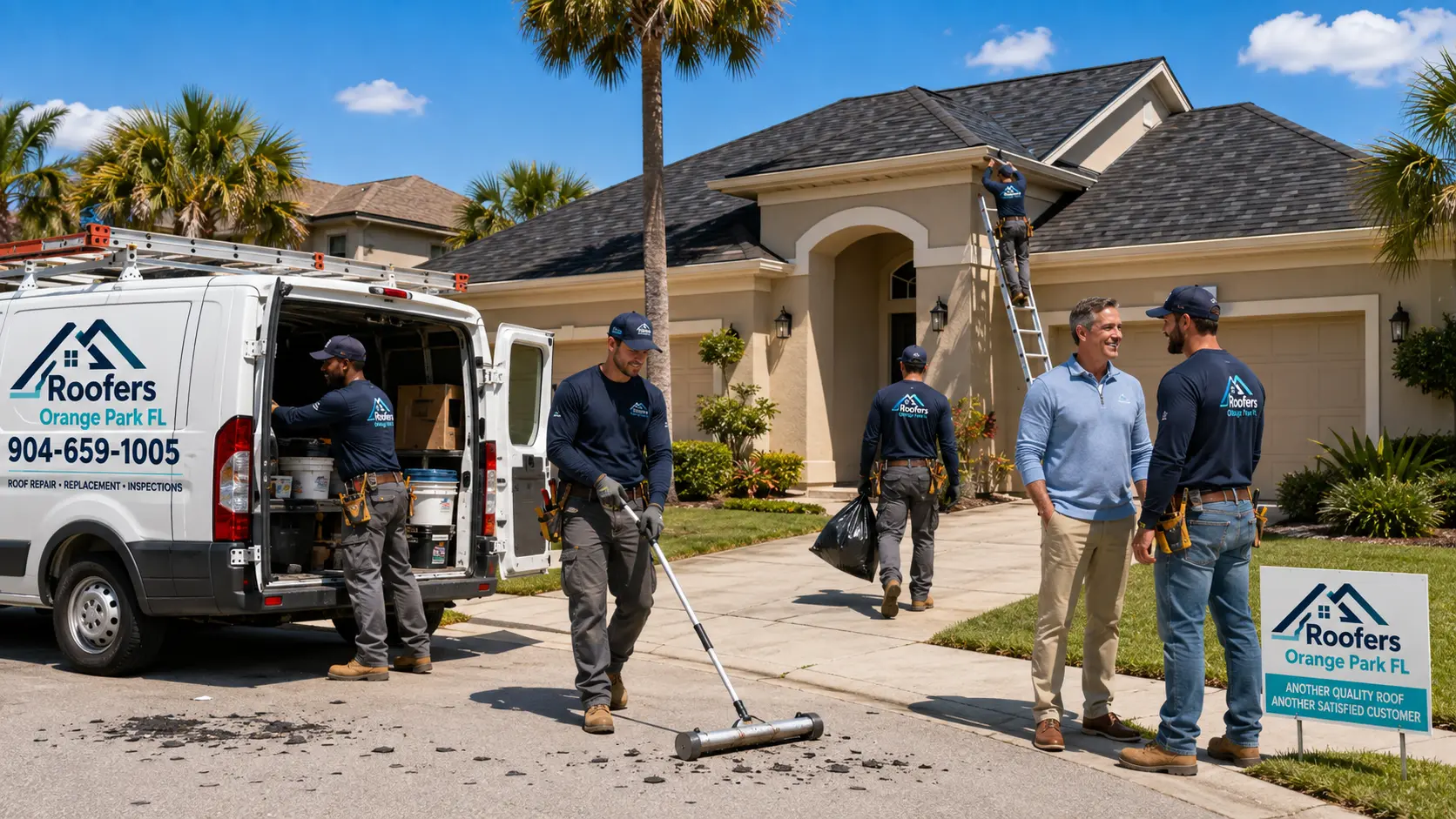
Residential roofing
Shingle and metal roof systems on single-family homes — underlayment, flashing, valleys, pipe boots, drip edge and attic ventilation evaluated as one assembly rather than patched one symptom at a time. From the first honest evaluation to a complete reroof.
Residential roofing in Orange Park →Roof replacement & new installation
A full replacement is a complete rebuild of the roof system: tear-off, decking evaluation and replacement where needed, underlayment, flashing at every transition, balanced ventilation, and the surface material you choose — architectural shingle or metal. Every layer is planned as one assembly so the next roof lasts.
Roof replacement in Orange Park →
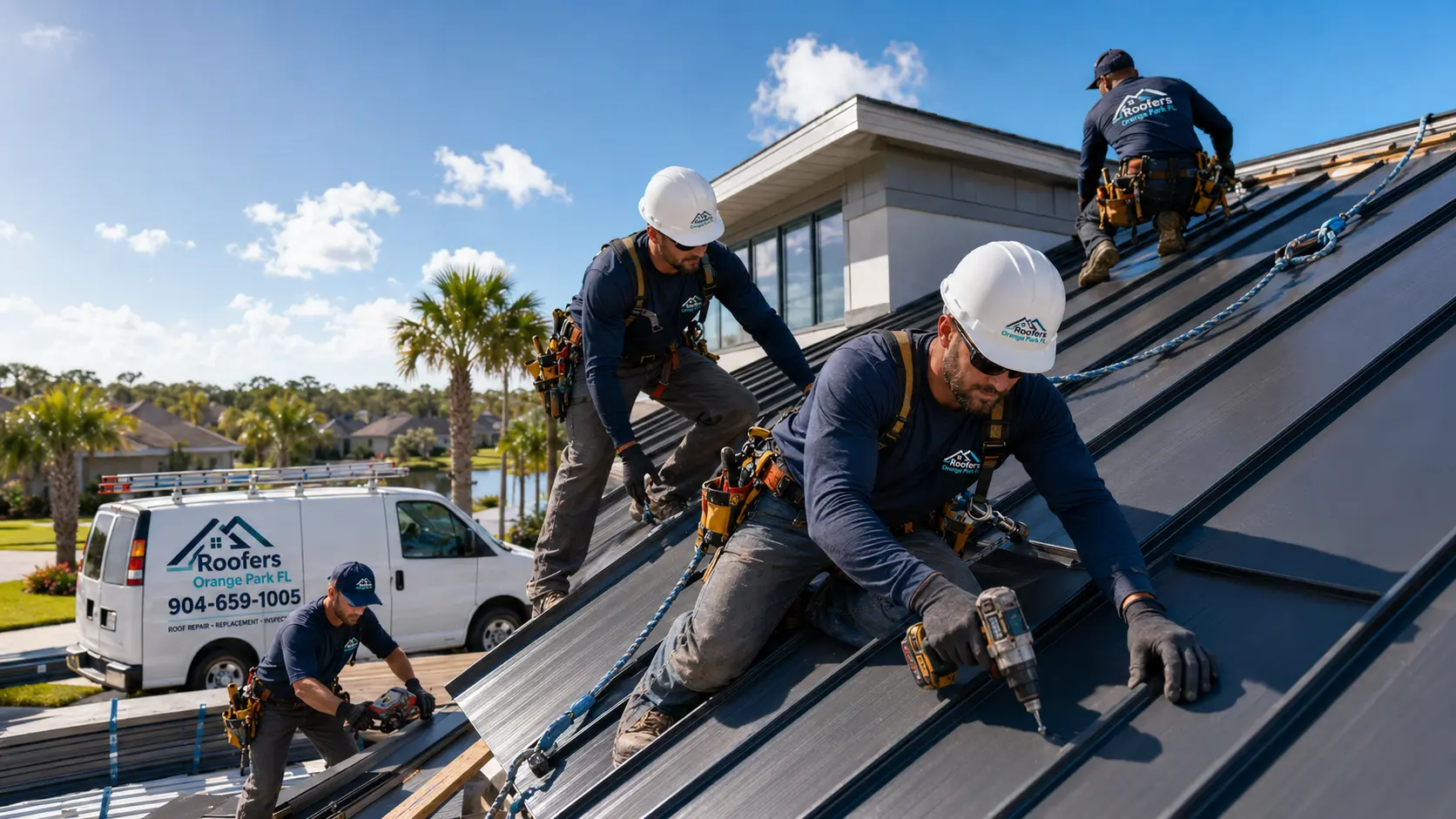
Shingle vs metal roofing
Architectural asphalt shingle costs less up front, repairs easily and fits most neighborhoods and HOA guidelines. Metal costs more, typically lasts considerably longer, sheds wind-driven rain exceptionally well, and demands precise detailing at penetrations and transitions.
Neither is universally better. If you plan to own the property a long time, metal's longer service life spreads the cost across more years. If you may move in a few years, a quality shingle system is usually the more rational spend.
Storm damage assessment
Wind creates uplift that concentrates at edges, corners, rakes and ridges — which is why storm damage almost always starts at a perimeter. The most consequential damage is often invisible from the ground: shingles whose sealant strips broke are still lying flat but are no longer bonded.
We inspect, document conditions with photographs, and explain how much damage the storm actually did and what it means for the roof's remaining service life. Insurance coverage is determined by your policy and your insurer — we provide roofing findings, not claim promises.
Storm damage roof inspection →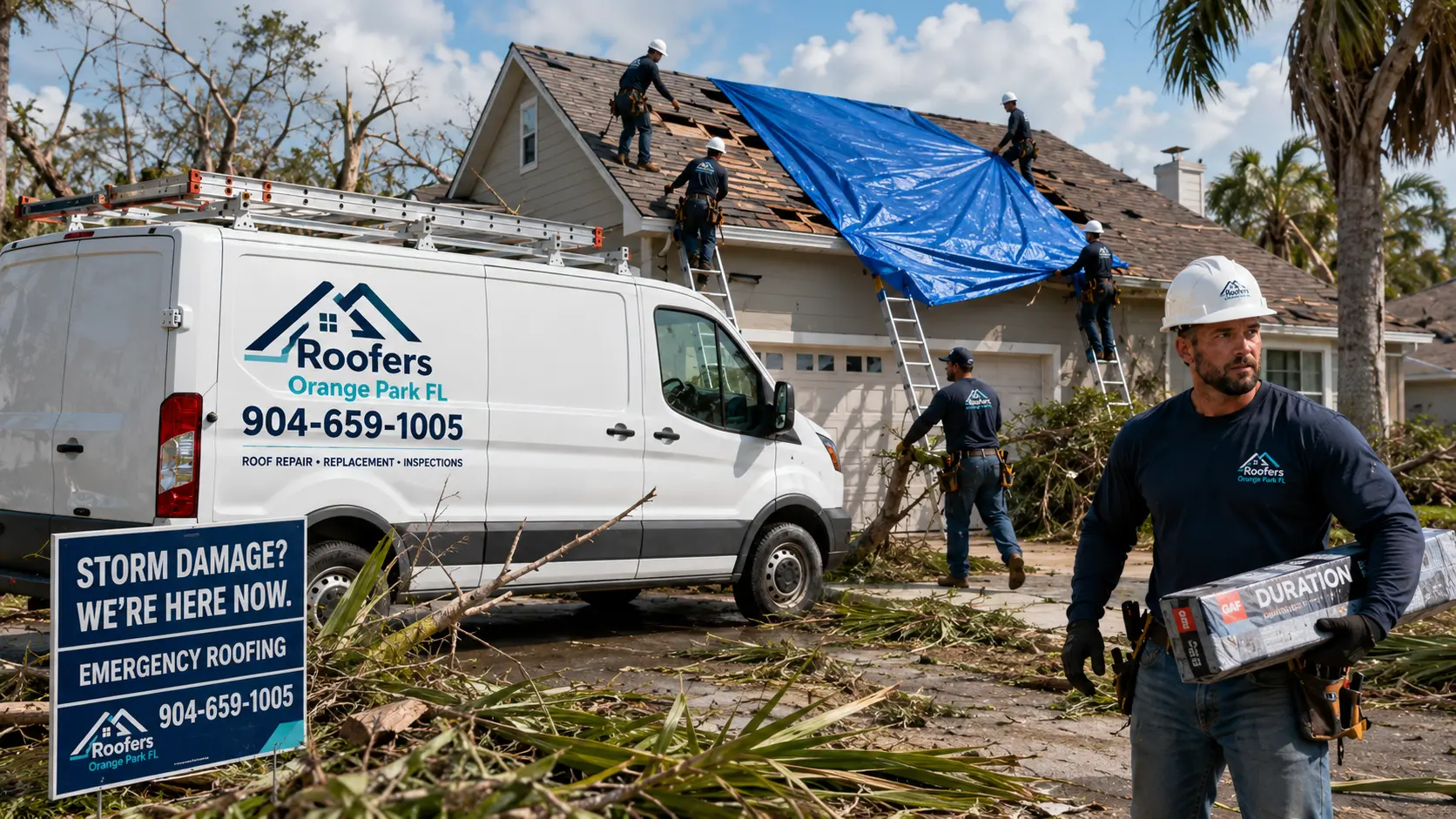
Our roofing process
- 1. Conversation — you describe the symptom, roof age if known, and any repair history.
- 2. Inspection — visual assessment of the roof surface, details and, where accessible, the attic side.
- 3. Findings — what we saw and what is causing it, in plain language, with photographs.
- 4. Options — a written scope and price, with an honest read on whether replacement makes sense now or later.
- 5. Scheduling — a realistic timeframe based on actual workload and weather.
- 6. Property protection — landscaping, driveways, entries and equipment covered before work starts.
- 7. The work — tear-off, decking evaluation and replacement where needed, underlayment, flashing, field material, ventilation.
- 8. Cleanup and walkthrough — debris removed, magnet sweep, and a review of what was done.
Roofing across Orange Park & Clay County
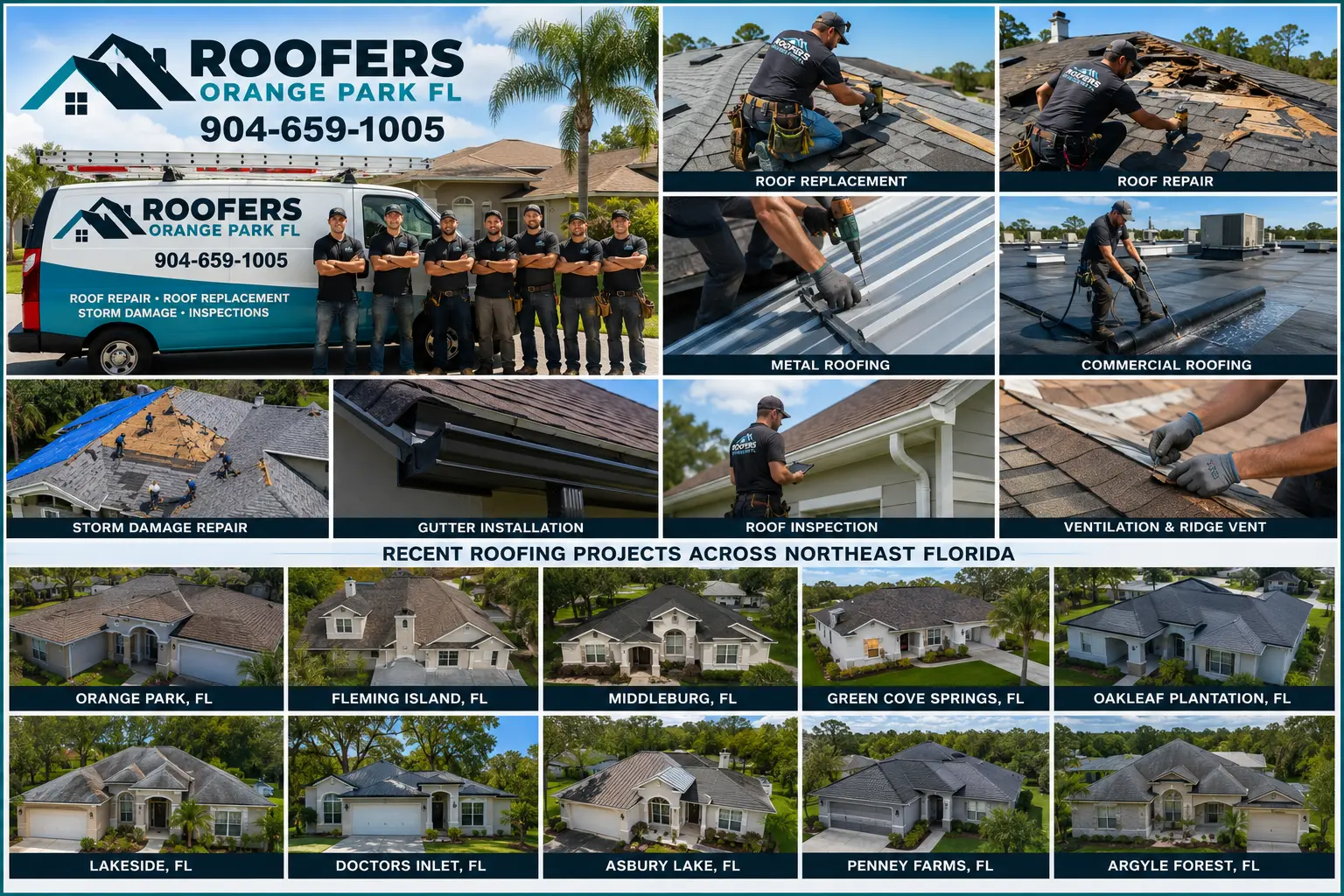
Representative project and service imagery showing the kind of work we do — roof replacement, shingle and metal installation, storm damage assessment, inspections and ventilation — across Northeast Florida communities.
Clay County & Southwest Jacksonville service areas
What You Can Expect From Our Roofing Process
We focus on making the roofing process clear, organized, and easy to understand from the first conversation through project completion.
Clear Communication
We explain what we see, what your options are, and what the next steps may involve so you can make an informed roofing decision.
Straightforward Recommendations
Repair and replacement recommendations should be based on the condition of the roof and the scope of the problem—not pressure to choose the largest project.
Organized Scheduling
We aim to keep homeowners informed about scheduling, material planning, weather considerations, and major project milestones.
Property Protection
Roofing work should be planned with attention to landscaping, driveways, exterior surfaces, and the areas surrounding the home.
Jobsite Cleanup
A roofing project is not finished until tools, materials, packaging, and job-related debris have been addressed.
Materials Explained
We help homeowners understand roofing materials, components, and practical differences between available options.
Have a Roofing Question?
Tell us what is happening with your roof and we can help you determine the next step.
About Roofers Orange Park FL
We are a local roofing company focused on Orange Park, communities throughout Clay County, and nearby Southwest Jacksonville. The work is deliberately practical: inspect first, explain what was found, and recommend the scope that fits the roof rather than the largest available project. If your roof has years of service left, we will tell you — and when it is time, we will build the replacement properly.
More about how we work · How our team works · Roofing guides
Follow us
Connect With Us on Facebook
See recent residential roofing work from Orange Park and Clay County homes — project updates, shingle and metal material walk-throughs, and seasonal roof care reminders — on our official Facebook page.
Frequently asked roofing questions
How do I know if my roof needs repair or replacement?
It comes down to age, pattern and decking. A roof in the earlier or middle part of its service life with one identifiable failure — a cracked pipe boot, a flashing detail, a wind-damaged section — often still has years of service left, and we will tell you that. A roof that is failing in several different places, has shingles that crack when lifted, shows widespread granule loss, or has soft decking is telling you it is at the end. Multiple previous patches on the same roof is another strong signal. We inspect and give you a straight answer about where your roof stands.
Does a leak mean I need a whole new roof?
Not automatically. A single leak on a roof whose material is otherwise sound can be a contained problem, and an honest evaluation will tell you which situation you are in. Replacement becomes the sensible spend when the roof is failing in multiple locations, the shingles are brittle across the roof, or the decking has been repeatedly saturated — at that point you would be paying repeatedly while the interior stays exposed.
What affects the price of a roof replacement?
Roof size and pitch, complexity — valleys, dormers, chimneys and penetrations all add labor — the material selected, how much decking has to be replaced once the old roof comes off, the amount of flashing work required, access constraints on the property, and any ventilation corrections. Decking is the most common variable that moves the final number, which is why we quote it at a defined per-sheet rate rather than pretending we can see through the existing roof.
How long can a roof replacement take?
It genuinely depends on the roof. A straightforward single-story shingle reroof is a very different project from a steep, cut-up roof with multiple dormers, or a metal system with extensive flashing work. Weather moves schedules in Florida, and decking replacement adds time. We give you a realistic expectation for your specific roof when we quote it, and we tell you if rain is going to push the schedule.
What happens if damaged decking is discovered during a replacement?
It gets replaced. A new roof cannot be fastened reliably to soft, delaminated or rotted sheathing, and covering it hides a problem that will keep getting worse. Because decking condition is not fully visible until tear-off, we identify a per-sheet replacement rate in the estimate up front so the cost is known in advance, and we show you what had to be replaced.
What causes roof leaks in Florida?
Rarely the middle of the roof. Leaks concentrate where the roof is interrupted: cracked pipe boots around plumbing vents, failed flashing at chimneys and roof-to-wall transitions, worn or debris-clogged valleys, skylight perimeters, nail pops, and shingles whose seal strips broke in a storm. Wind-driven rain is the aggravating factor — water pushed sideways and uphill finds gaps that vertical rainfall never would.
Can a roof leak be coming from somewhere other than directly above the stain?
Yes, and this is one of the most common misunderstandings about roof leaks. Water entering at the deck follows framing — down a rafter, across the top of a ceiling joist, along a truss chord — until it finds a low point to drop. The stain forms where the water finally falls, which can be well away from the entry point. Chasing the stain instead of locating the source is why some roofs get repaired three times for the same leak.
What causes stains on ceilings after heavy rain?
Usually a roof entry point that only leaks under specific conditions — heavy volume, or rain driven from a particular direction. Light rain drains normally; heavy or wind-driven rain overwhelms a marginal flashing, backs up behind a clogged valley, or rises above a detail's effective height. Condensation from ductwork or plumbing leaks in the attic can also cause stains, which is why we look at the attic side when it is accessible rather than assuming.
Ready to get your roof looked at?
Call 904-659-1005 or request an estimate and describe what your roof is doing.
Contact Roofers Orange Park FL
Roofers Orange Park FL
550 Wells Rd Suite 479
Orange Park, FL 32073
904-659-1005
info@roofersorangeparkfl.com
Monday through Friday, standard business hours. Messages left outside business hours are returned the next business day.
Roofers Orange Park FL serves Orange Park, communities throughout Clay County, and nearby Southwest Jacksonville.