Roofing service
Commercial Roofing in Orange Park, FL
Low-slope and flat roofing support for Orange Park businesses, property managers and building owners across Clay County.
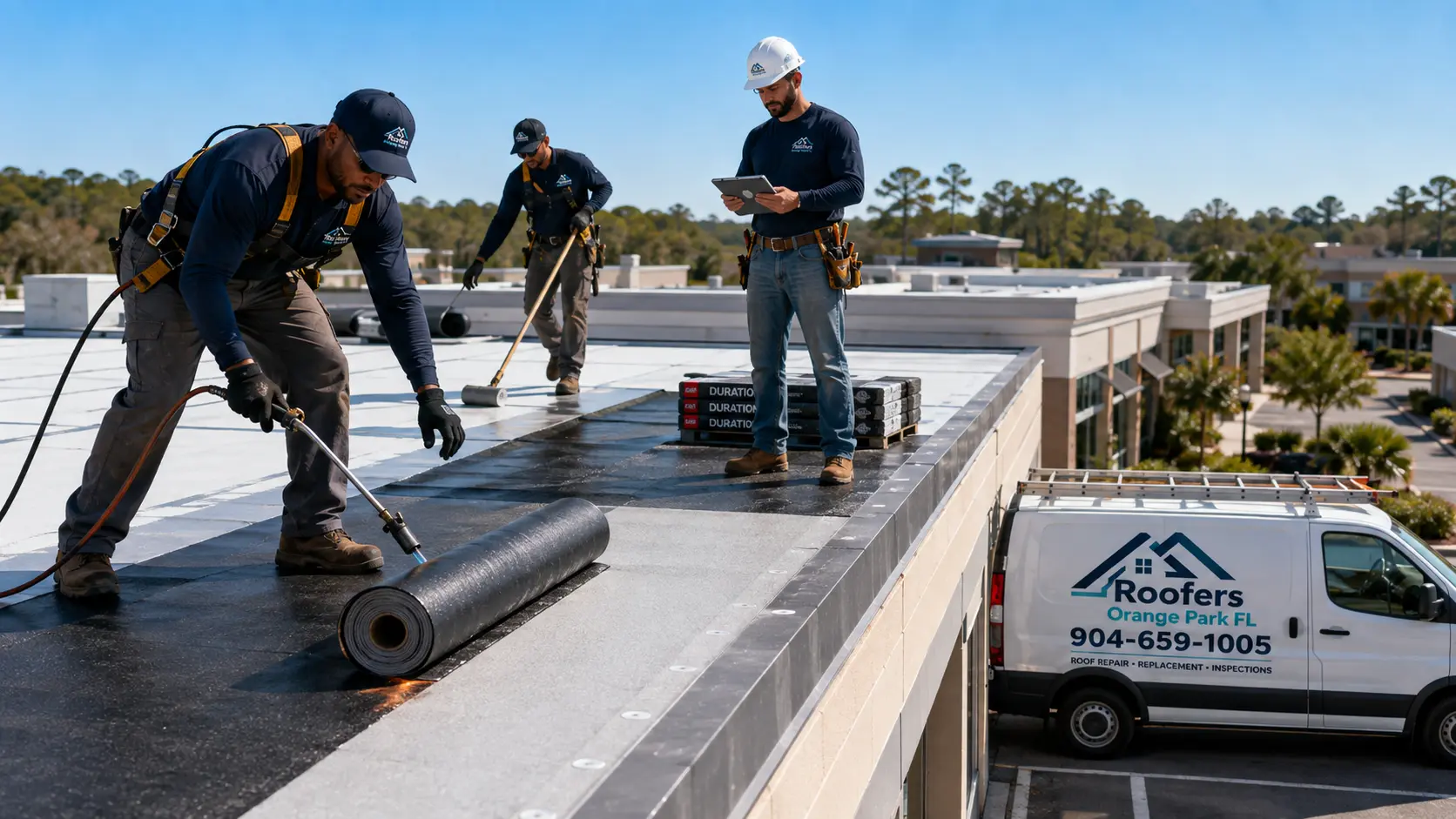
A low-slope commercial roof does not shed water the way a pitched residential roof does. It manages water — moving it toward drains and scuppers across a surface that is nearly flat. That distinction drives everything about how these roofs fail and how they should be maintained.
Roofers Orange Park FL works with commercial and light-commercial properties around Orange Park and Clay County: retail suites, office buildings, small warehouses and mixed-use structures. Whether you are managing a recurring leak over a tenant space or trying to build a realistic capital plan for a roof that is aging out, the first step is understanding the actual condition of the system.
Low-slope roofing systems
Most low-slope commercial roofs in this market fall into a few families: single-ply membranes such as TPO and EPDM, modified bitumen systems installed in rolls, and older built-up roofing. Each has its own seam methodology, repair approach and failure profile.
Identifying what you actually have matters, because a repair method appropriate to one membrane can be actively harmful to another. Part of any commercial evaluation is confirming the system and its approximate age before recommending anything.
Drainage is the defining issue
On a nearly flat roof, water leaves through drains, scuppers and gutters — not by running downhill quickly. When drainage is compromised, water sits. Standing water accelerates membrane degradation, adds structural load, collects debris and finds any seam weakness given enough time.
Common drainage problems we find include clogged or undersized drains, crushed or blocked scuppers, ponding in low areas caused by deck deflection or insufficient slope, and debris accumulation around rooftop equipment where nobody walks.
A significant share of commercial leak calls resolve to a drainage issue rather than a membrane defect.
Penetrations and rooftop equipment
Commercial roofs are perforated by far more than residential ones: HVAC curbs, exhaust fans, plumbing vents, conduit supports, antenna mounts, gas lines and grease ducts. Every one of them is a detail that has to be flashed and maintained.
Rooftop equipment also brings service technicians who walk the roof, set tools down, and occasionally cut into things. HVAC service damage is a real and underappreciated cause of commercial roof leaks. Walk pads and clear service routes are worth having.
Curb flashing, pitch pockets and sealed conduit penetrations should be inspected on a schedule rather than only after a tenant reports water.
Repair, maintenance or replacement
Commercial roofs reward maintenance more than residential roofs do, because small membrane issues are cheap to correct and expensive to ignore. A leak over a tenant space is not just a roofing cost — it is drywall, ceiling tile, flooring, inventory and potentially lease exposure.
Replacement becomes the conversation when the membrane has broadly reached the end of its service life, when insulation beneath the membrane is saturated across large areas, or when the number of active leaks makes a repair-by-repair approach unrealistic.
We will give you a straight read: whether this roof is a maintain-and-monitor asset for a few more years or something you should be budgeting to replace.
Working around a functioning business
Commercial roofing work happens over occupied space. That means coordinating around business hours where practical, keeping access routes and parking usable, communicating with tenants in advance, managing noise expectations, and staging materials without blocking operations or fire lanes.
For property managers, we understand that the reporting matters as much as the work — documentation of what was found, what was done, and what remains outstanding is part of the deliverable.
For property managers and landlords
- Condition assessments to support capital planning and budgeting conversations.
- Documented repair scopes rather than verbal descriptions.
- Photos of conditions found and work completed.
- Prioritized recommendations separating urgent items from monitor-and-revisit items.
- Coordination with tenant schedules and building access requirements.
- Honest assessment of remaining service life rather than an automatic replacement pitch.
Florida-specific commercial considerations
Intense UV exposure ages exposed membranes and degrades sealants at penetrations. Heavy seasonal rainfall tests drainage capacity repeatedly. Wind uplift on a large, flat, uninterrupted roof plane is a genuine engineering concern, particularly at perimeters and corners where pressures are highest.
Humidity also means that once water gets into the insulation layer beneath a membrane, it does not dry out. Wet insulation loses thermal value and holds moisture against the deck indefinitely, which is why identifying and correcting leaks promptly matters more here than in a drier climate.
Commercial Roofing questions
Do you work on commercial roofs?
Yes. We handle low-slope and flat commercial roofing for Orange Park and Clay County properties, including repair, drainage and penetration issues, condition assessment and replacement planning. Call 904-659-1005 to discuss the building.
Why does my commercial roof leak only during heavy rain?
That pattern usually points to drainage rather than a membrane hole. In lighter rain the roof drains adequately; in heavy rain water backs up, rises above a seam, curb or flashing height, and finds a path in. Correcting the drainage often resolves it.
What is ponding water and does it matter?
Ponding is water that remains on the roof well after rainfall stops, typically in low areas from deck deflection or inadequate slope. It accelerates membrane aging, adds structural load, promotes debris and biological growth, and magnifies any nearby seam weakness. It is worth addressing.
Can you repair the roof without disrupting my tenants?
For most repairs, yes — the work happens above them. We coordinate access, staging and timing to limit disruption, and we notify you of anything that will produce significant noise or require interior access. Full replacements require more planning and communication.
Do you handle roofs damaged by HVAC service work?
Frequently. Curbs, pitch pockets, conduit supports and membrane punctures from equipment service are common. We repair the roofing side and can document the condition for you.
How often should a commercial roof be inspected?
A twice-yearly visual check plus an inspection after any significant storm is a reasonable baseline for most low-slope roofs, along with keeping drains clear seasonally. Buildings with heavy rooftop equipment or frequent service traffic benefit from more attention.
Can you give me something I can take to ownership for budgeting?
Yes. We provide written findings with photos and a prioritized scope so you can distinguish what needs to happen now from what can reasonably be scheduled into a future budget cycle.
Related roofing services
Where we provide this service
Commercial Roofing is available across Orange Park, communities throughout Clay County, and nearby Southwest Jacksonville, including Orange Park, Fleming Island, Middleburg, Green Cove Springs, Oakleaf Plantation, Lakeside, Bellair-Meadowbrook Terrace, Doctors Inlet, Asbury Lake, Argyle Forest, Eagle Harbor, Pace Island. See all service areas.
Ready to get your roof looked at?
Call 904-659-1005 or request an estimate and describe what your roof is doing.