
Roofing service
Roof Repair in Orange Park, FL
Leaks, lifted shingles, failed flashing and storm-related damage — targeted roof repair for Orange Park homes and businesses.
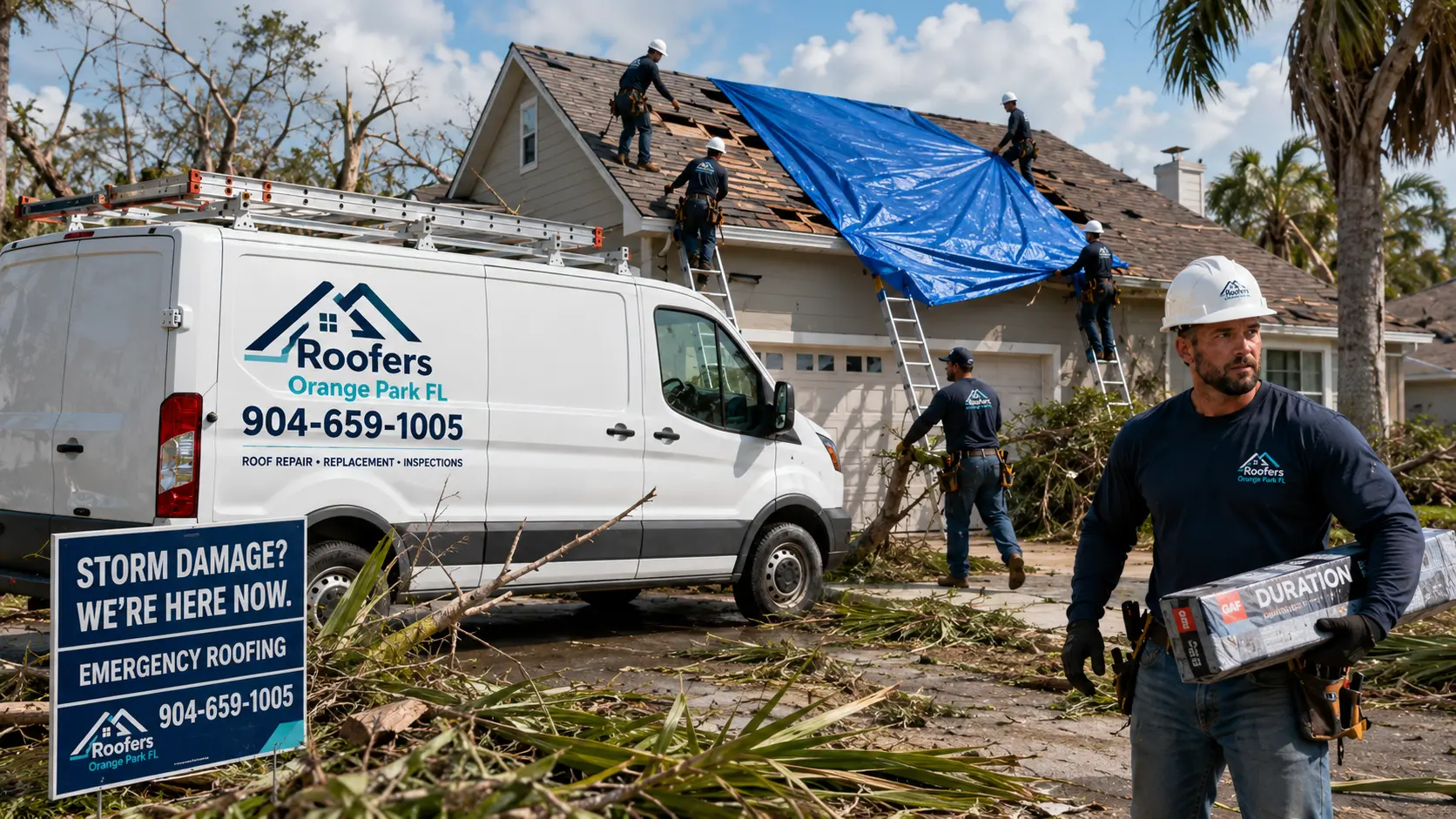
Roof repair starts with a question that sounds simple and rarely is: where is the water actually getting in? A stain in the corner of a living room ceiling can originate from a pipe boot eight feet away, a wall flashing on a second-story dormer, or a valley two roof planes over. Water follows the path of least resistance along framing before it drops, so the visible damage inside and the failure point outside are often in different places.
Roofers Orange Park FL handles roof repair throughout Orange Park, Fleming Island, Middleburg, Green Cove Springs and the communities throughout Clay County and nearby Southwest Jacksonville. Most of the repairs we make fall into recognizable categories, and most of them are fixable without replacing an entire roof — provided the rest of the system still has life in it.
If water is actively entering your property, call 904-659-1005 and describe what you are seeing so we can prioritize appropriately.
Roof leaks and what actually causes them
In our experience across Northeast Florida, the field of the roof — the broad, uninterrupted shingle surface — is rarely where a leak begins. Leaks concentrate wherever the roof is interrupted or where two things meet.
- Cracked or deteriorated pipe boots around plumbing vents. UV exposure hardens the rubber collar until it splits, and water runs down the pipe into the attic.
- Failed flashing at chimneys, dormers and roof-to-wall transitions, particularly where step flashing was omitted or replaced with sealant.
- Valley problems where debris has dammed water or the valley material has worn through.
- Nail pops — fasteners that back out over time and lift the shingle above them, creating a small entry path.
- Skylight perimeter seals that have aged past their useful life.
- Wind-lifted shingles that broke their seal strip and no longer lay flat against the course below.
- Missing shingles that leave underlayment exposed to direct sun until it degrades.
- Backed-up or undersized gutters that let water sit against the drip edge and fascia.
Wind and storm-related roof damage
Northeast Florida gets both routine summer thunderstorms and occasional tropical systems. Damage from each looks different. Everyday storms tend to break shingle seals along edges and ridges and to knock debris loose. Tropical wind events produce more obvious loss — missing shingle sections, displaced ridge caps, torn flashing and impact damage from branches.
The damage that concerns us most is the kind that is not obvious from the ground. A shingle that has broken its seal but has not blown off still looks fine from the driveway. In the next storm it becomes an open door. After a significant wind event it is worth having the roof looked at even if nothing appears to have moved.
Flashing, vents, valleys and penetrations
Flashing is the metal detail that bridges the roof surface and something else — a wall, a chimney, a curb. Done correctly it directs water back onto the roof. Done poorly, or replaced over the years with caulk, it becomes a reliable leak.
Repairs at these details are more involved than swapping a shingle because they usually require lifting and reworking the surrounding courses so the new flashing tucks under the material above it and over the material below it. Sealant on top of a flashing failure is a temporary measure, not a repair, and we will tell you when that is all that has been done previously.
Penetrations — pipe boots, exhaust vents, attic fans, satellite mounts — should be inspected any time the roof is being evaluated. A boot replacement is one of the least expensive repairs available and prevents one of the most common leaks.
When a repair is the right call
Repair makes practical sense when the roof system still has meaningful service life left and the damage is confined. Indicators pointing toward repair include a roof in the earlier or middle part of its life, material that is still flexible and well-adhered, a single identifiable failure point, and decking that is sound around the affected area.
When repeated repairs stop being economical
There is a point where continuing to repair a roof costs more over a few years than replacing it, and the property is exposed to water damage in the meantime. Signs you may have reached it include leaks appearing in new locations each season, shingles that crack or crumble when lifted, widespread granule loss with underlying mat showing, multiple areas of soft decking, and a history of three or more repairs on the same roof.
We will give you an honest read on which side of that line your roof is on. If the roof has years left, a repair is the right spend. If it does not, spending on repairs delays the inevitable while the attic and interior take on water.
What a repair visit looks like
- You describe the symptom — where the stain is, when it appears, whether it is tied to wind direction or rainfall intensity.
- We inspect the roof surface, the suspected area and the surrounding details, plus the attic side where it is accessible.
- We identify the entry point and explain what failed and why.
- You get a written scope and price for the repair, plus a note on anything else observed that may need attention later.
- The repair is performed so the new material integrates into the existing courses and sheds water correctly.
- Debris is removed and the surrounding ground is swept for fasteners.
Roof Repair questions
Can an isolated roof leak be repaired without replacing the whole roof?
In most cases, yes. If the roof material is still in serviceable condition and the failure is confined to a penetration, a flashing detail, a valley or a limited shingle area, a repair is the appropriate fix. Replacement becomes the better option when the same roof keeps failing in new places.
Why does my ceiling stain appear in a different spot from where the roof is damaged?
Water entering at the roof deck travels along the path of least resistance — down a rafter, across the top of a ceiling joist, or along a truss — before it finds a place to drop. That is why locating the entry point matters more than treating the area directly above the stain.
Can missing shingles just be replaced?
Often yes, though matching matters. Shingle colors weather over time and product lines change, so an exact match on an older roof is not always possible. We will tell you honestly whether the repair will be visually noticeable before we do it.
How soon should I address a small leak?
Sooner is meaningfully better. A small entry point wets decking and insulation every time it rains, and in a humid climate that leads to persistent moisture, degraded sheathing and, eventually, a larger and more expensive scope of work.
Do you offer emergency or same-day response?
We do not advertise a guaranteed emergency response window. What we can do is take your call at 904-659-1005, understand the severity, and schedule you as promptly as our current workload allows. If water is actively entering the building, tell us that when you call.
Is sealant a legitimate roof repair?
Sealant has legitimate uses as part of a correctly detailed repair. It is not a substitute for flashing, a properly installed boot or correctly lapped shingles. A roof held together primarily by caulk will keep leaking, usually within a year or two.
Will a repair void anything on my roof?
We cannot speak to the terms of a warranty we did not issue. If your roof is under an existing manufacturer or installer warranty, review those terms before authorizing work by anyone, including us.
Related roofing services
Where we provide this service
Roof Repair is available across Orange Park, communities throughout Clay County, and nearby Southwest Jacksonville, including Orange Park, Fleming Island, Middleburg, Green Cove Springs, Oakleaf Plantation, Lakeside, Bellair-Meadowbrook Terrace, Doctors Inlet, Asbury Lake, Argyle Forest, Eagle Harbor, Pace Island. See all service areas.
Ready to get your roof looked at?
Call 904-659-1005 or request an estimate and describe what your roof is doing.