
Roofing service
Residential Roofing in Orange Park, FL
Roofing work built around single-family homes in Orange Park and the surrounding Clay County neighborhoods — from a single leaking valley to a complete reroof.
A house in Northeast Florida asks a lot of its roof. Summer surface temperatures on dark asphalt shingles climb far above the air temperature, afternoon thunderstorms arrive almost daily for months, humidity keeps organic debris damp on north-facing slopes, and tropical systems push rain sideways under materials that were designed to shed water downward. Residential roofing here is less about a single product and more about how the whole assembly handles that combination year after year.
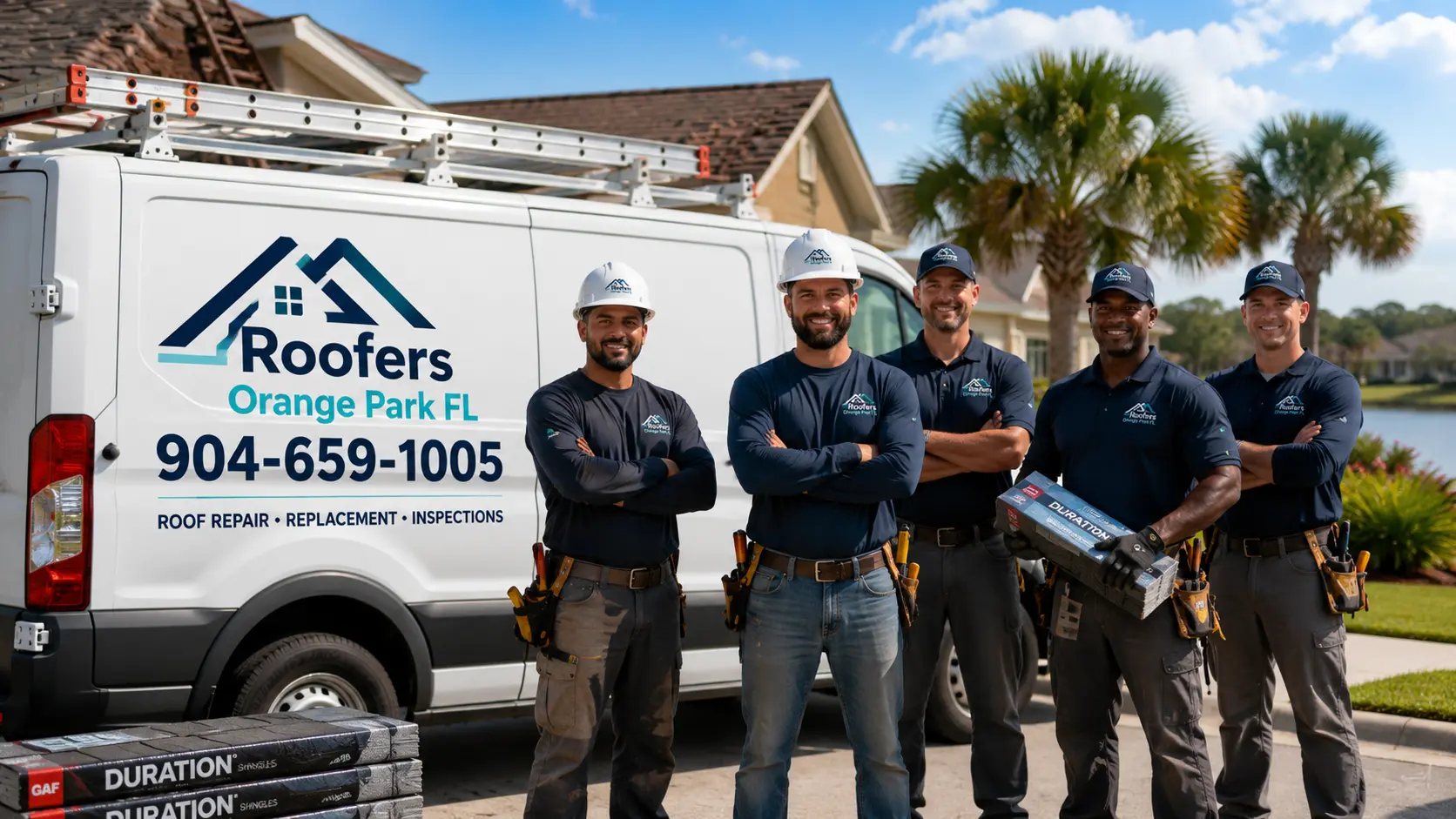
Roofers Orange Park FL works on the residential side every week: shingle homes in the established neighborhoods off Kingsley Avenue and Blanding Boulevard, newer planned communities with large uninterrupted roof planes, and older properties where a few decades of patch repairs have layered on top of each other. The work ranges from a two-hour repair to a full tear-off and rebuild of the roof system.
This page explains how residential roofing actually works on a Florida home, what we look at during an evaluation, and how repair and replacement decisions get made. If you would rather just talk it through, call 904-659-1005 and describe what you are seeing.
What a residential roof system is made of
Homeowners often think of a roof as shingles. The shingles are only the outermost layer. Underneath, a residential roof is a stack of components that each have a job, and a failure in any one of them can show up as a stain on a bedroom ceiling.
- Roof decking — usually plywood or OSB sheathing fastened to the trusses. Decking that has been repeatedly wet becomes soft and will not hold fasteners reliably.
- Underlayment — the water-resistant layer over the decking. It is the secondary defense when wind drives rain past the surface material.
- Starter course and drip edge — the edge details that resist wind uplift and direct water into the gutter instead of behind the fascia.
- Field material — architectural asphalt shingles on most Orange Park homes, or metal panels on a growing number of them.
- Flashing — metal at chimneys, walls, skylights and roof-to-wall transitions. Flashing problems cause a large share of the leaks we find.
- Valleys — where two roof planes meet and concentrate a lot of water into a narrow path.
- Penetrations — pipe boots, vents, exhaust caps and satellite mounts. Rubber pipe boots crack under Florida UV exposure and are a very common leak source.
- Ventilation — ridge vents, off-ridge vents, soffit intake. Without balanced intake and exhaust, attic heat and moisture shorten the life of everything above it.
Common residential roofing problems in Orange Park
Most calls we take from Orange Park homeowners fall into a handful of recognizable patterns. Knowing which pattern you are looking at usually tells you whether you are facing a repair or a larger project.
- A ceiling stain that appears only during heavy, wind-driven rain — often a flashing, valley or penetration issue rather than a hole in the field of the roof.
- Shingles lifted or missing along a rake edge or ridge after a storm, exposing underlayment to direct sun.
- Granule loss visible in gutters and at downspout outlets, with shingle surfaces looking thin or shiny.
- Cracked pipe boots — the rubber collar around a plumbing vent splits after years of UV exposure and lets water run straight down the pipe into the attic.
- Soft or spongy decking felt underfoot, which usually means water has been getting in for a while.
- Dark streaking across a shaded slope, typically algae growth rather than structural failure, though it often accompanies a roof that stays damp.
- Repeat leaks in the same area that have been patched more than once.
How we evaluate a residential roof
An evaluation is a visual condition assessment, not a guess from the driveway. We look at the roof surface where it is safe to do so, examine the details that commonly fail, and where accessible we check the underside of the decking in the attic for staining, daylight or damp insulation.
The point is to connect the symptom you are experiencing inside the house to the actual entry point on the roof. Water rarely enters directly above the stain. It can travel along a rafter, across the top of a ceiling joist, or down a truss chord before it drops. Chasing the stain instead of the source is why some roofs get repaired three times for the same leak.
After the walkthrough we explain what was found in plain language, including photos where they help, and lay out the reasonable options. If a repair makes sense, we say so. If the roof is at the end of its life and a repair only buys a season, we say that too.
Repair, partial work, or full replacement
There is no universal cutoff. The decision depends on the age of the existing system, how widespread the wear is, the condition of the decking, how many previous repairs are already on the roof, and what you plan to do with the property.
A roof in reasonable shape with one damaged area is a repair. A roof with failing material across multiple slopes, brittle shingles that crack when lifted, or decking that has been repeatedly saturated is usually a replacement conversation. In between there are partial-slope options that can make sense when damage is confined to one plane and the material can still be matched reasonably.
We walk through the tradeoffs rather than pushing the largest project. A homeowner planning to sell in a year and a homeowner planning to stay for fifteen are looking at genuinely different math.
Why Florida conditions change residential roofing decisions
Heat accelerates the aging of asphalt. Shingles that would last comfortably in a milder climate lose flexibility and granule adhesion faster under sustained Northeast Florida sun, particularly on south and west-facing slopes with no shade.
Wind-driven rain is the other major factor. Water pushed uphill under a shingle course or sideways into a wall transition finds gaps that vertical rain never would. That is why underlayment quality, sealed edges and correct flashing detail matter as much as the shingle itself.
Attic ventilation deserves more attention than it usually gets. A hot, humid, poorly vented attic bakes the underside of the decking, cooks the shingles from below, and can condense moisture on framing during shoulder seasons. Correcting intake and exhaust balance during a reroof is one of the more valuable things you can do for the next roof's lifespan.
Our residential roofing process
- Conversation — you describe the symptom, the age of the roof if known, and the history of any previous work.
- On-site evaluation — visual inspection of the roof surface, details and, where accessible, the attic side.
- Findings and options — what we saw, what is causing it, and the practical paths forward with a written estimate.
- Scheduling — we confirm the plan, materials and access needs, and coordinate a date.
- Property protection — landscaping, driveways, pool cages, entries and AC units get covered or kept clear before work begins.
- The work — tear-off or repair, decking evaluation and replacement where needed, underlayment, flashing, field material, penetrations and ventilation.
- Cleanup — debris removal and magnet sweep of the drive and surrounding ground.
- Final walkthrough — we go over what was done and what to watch for.
Residential Roofing questions
Do you repair roofs, or only replace them?
Both. A large share of our residential work is repair — flashing, pipe boots, valleys, wind-damaged shingle sections and localized leaks. Replacement is recommended when the roof system as a whole is failing, not because a repair is inconvenient. If a repair will genuinely solve the problem, that is what we will suggest.
How long does an asphalt shingle roof last on an Orange Park home?
Manufacturer service-life ranges for architectural asphalt shingles are commonly quoted in the twenty to thirty year range, but Northeast Florida sun, humidity and storm exposure mean real-world performance is often shorter than the upper end of that range, especially on unshaded slopes with poor attic ventilation. Condition matters more than the number on the invoice — we look at the actual material.
Can you tell where a leak is coming from without tearing anything apart?
Usually, yes. Most residential leaks come from a limited set of predictable places — penetrations, flashing, valleys and edges. Combining what we see on the roof surface with what shows on the attic side of the decking normally identifies the entry point. Occasionally a stubborn leak requires opening a small area to confirm, and we discuss that before doing it.
Will you need to replace decking?
Sometimes. Decking condition is not fully visible until the old material comes off. If sheathing is soft, delaminated or damaged, it has to be replaced for the new roof to be fastened properly. We identify decking replacement as a separate line item so you are not surprised by it.
What happens to my landscaping and driveway during a reroof?
We cover and protect what we can, keep debris contained, and sweep the ground with a rolling magnet at the end of the job to collect nails. Roofing is inherently messy while it is happening; leaving the property clean when it is finished is part of the work, not an extra.
Do you work on metal residential roofs?
Yes. Metal is increasingly common on Clay County homes, and it has its own set of details — panel fastening, closures, flashing at transitions and penetrations. See our metal roofing page for how those systems differ from shingles.
Should I have my roof looked at even if I do not see a leak?
It is reasonable after a significant storm, before buying or selling a home, or when a roof passes fifteen years of age. Problems found early are usually smaller and cheaper than the same problem found after water has been entering the attic for a season.
Related roofing services
Where we provide this service
Residential Roofing is available across Orange Park, communities throughout Clay County, and nearby Southwest Jacksonville, including Orange Park, Fleming Island, Middleburg, Green Cove Springs, Oakleaf Plantation, Lakeside, Bellair-Meadowbrook Terrace, Doctors Inlet, Asbury Lake, Argyle Forest, Eagle Harbor, Pace Island. See all service areas.
Ready to get your roof looked at?
Call 904-659-1005 or request an estimate and describe what your roof is doing.