
Roofing service
Metal Roofing in Orange Park, FL
Standing seam and panel metal roofing installed with the flashing and fastening detail that humid, storm-exposed Florida properties require.
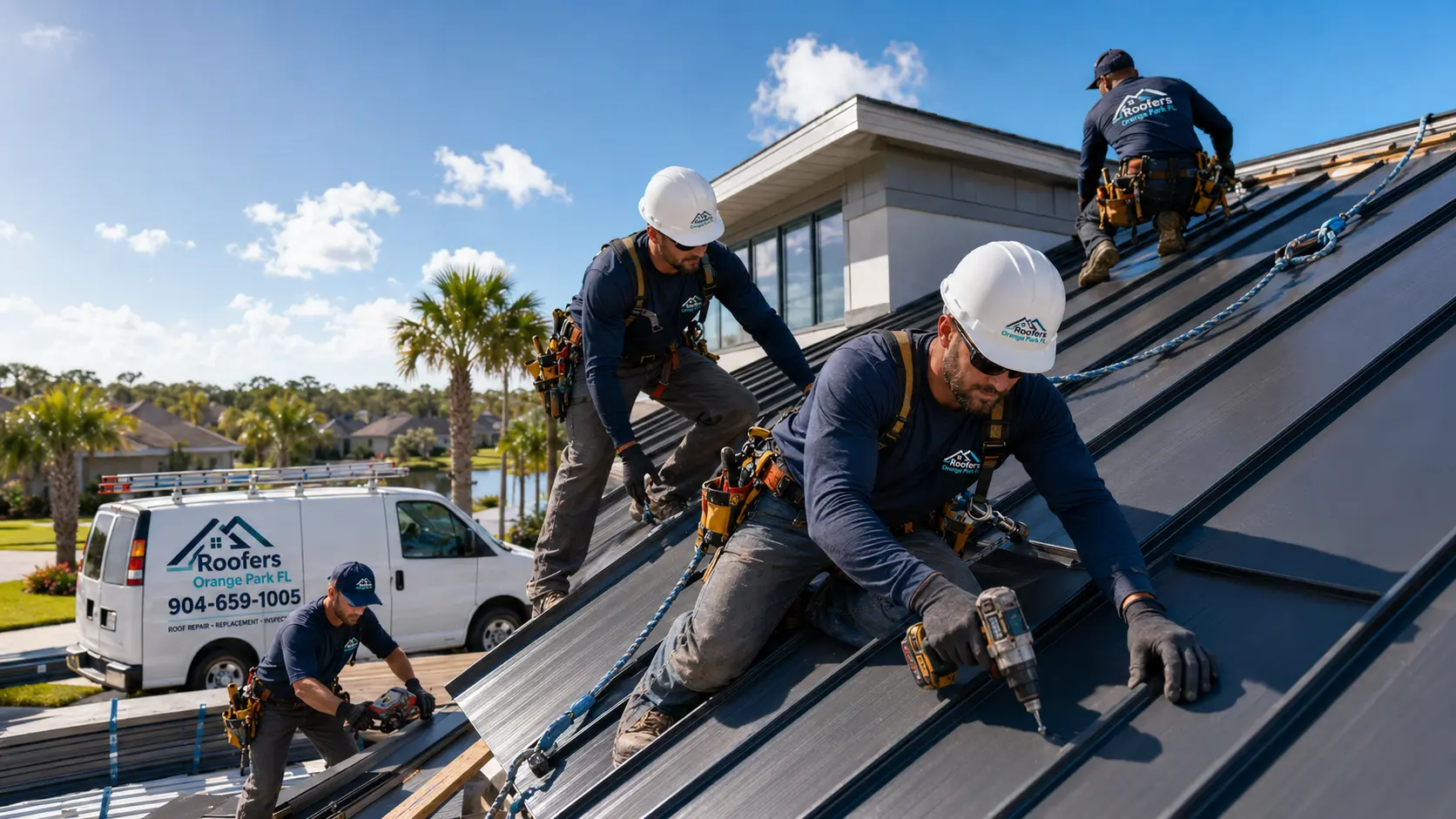
Metal roofs have moved from the agricultural fringe to mainstream residential roofing across Northeast Florida over the last two decades. Homeowners are drawn to the expected service life, the wind performance and the low maintenance profile.
What is less discussed is that metal is an unforgiving system. Asphalt shingles are self-correcting to a degree — hundreds of small overlapping pieces. A metal roof is a small number of long panels, and every place a panel is interrupted or fastened is a place that has to be detailed properly. Nearly every failing metal roof we are called to look at is failing at a detail, not in the middle of a panel.
Standing seam versus exposed-fastener systems
Standing seam is a concealed-fastener system. Panels are attached with clips hidden beneath the raised seams, and the seams are mechanically locked or snapped together. Nothing penetrates the water plane in the field of the roof, which is the primary reason these systems perform well long term.
Exposed-fastener panels — the ribbed profiles most people picture on barns and workshops — are screwed through the face of the panel into the structure below, with a rubber washer under each screw head sealing the hole. They cost less and install faster.
The tradeoff is maintenance. Those washers age, screws back out slightly under thermal cycling, and each one is a potential leak after enough years of Florida sun. Exposed-fastener roofs need periodic fastener inspection in a way standing seam does not. Both are legitimate systems; they just have different lifecycles and different expectations.
Flashing, penetrations and transitions
This is where metal roofing succeeds or fails. Every plumbing vent, exhaust, skylight, chimney, wall intersection, valley, ridge, hip and eave requires a purpose-made detail — boots designed for panel profiles, closures that fill the ribs, and flashing formed to work with the panel geometry.
Panels also expand and contract with temperature more than shingles do. Details have to accommodate that movement instead of fighting it. A rigidly fastened detail that ignores thermal movement will elongate its own holes over a few seasons and start leaking.
Corrosion and coating in a humid coastal-adjacent climate
Northeast Florida is humid year-round and close enough to the coast that salt-laden air is a real consideration for some properties. Metal roofing here should be specified with that environment in mind — appropriate substrate and coating, and compatible fasteners and flashings.
Mixing incompatible metals in contact with one another causes galvanic corrosion, and it shows up first at fasteners and flashing joints. It is a detail that gets overlooked on quick installations and is expensive to correct later.
Panels also need to shed debris. Where a roof sits under mature trees, organic debris trapped against a panel or in a valley holds moisture against the coating continuously.
Wind performance
Metal panel systems, properly attached to sound decking or structure with the manufacturer's specified clip or fastener spacing, perform well against wind. The critical word is 'properly.' Attachment spacing at perimeters and corners is typically tighter than in the field, because that is where uplift pressures concentrate.
Existing metal roofs that concern us are usually the ones where fastener spacing was uniform across the whole roof, or where panels were attached to marginal decking.
Heat, energy and comfort
Metal roofing with a reflective finish reflects a meaningful portion of solar radiation rather than absorbing it the way dark asphalt does, and metal does not retain heat into the evening the way a shingle roof can.
We are not going to attach a percentage savings figure to that, because the actual effect on your bill depends on your attic insulation, ventilation, ductwork location, air sealing and equipment. What we can say is that the roof is one input among several, and attic ventilation and insulation usually matter more than the surface material.
Lifespan and replacement planning
Metal systems generally carry longer expected service lives than asphalt, which changes the economics. If you plan to own the property for a long time, the higher upfront cost is spread across more years and potentially avoids an entire replacement cycle.
If you expect to move within a handful of years, the payback logic weakens considerably. There is no wrong answer here; there is a right answer for your situation and timeline, and we will lay out both options honestly.
Repairing an existing metal roof
- Fastener replacement on exposed-fastener panels where washers have failed or screws have backed out.
- Re-detailing penetrations where a boot has aged, cracked or was never correct for the panel profile.
- Flashing repairs at wall transitions, chimneys and curbs.
- Closure replacement at ridges and eaves where foam or metal closures have degraded.
- Sealant renewal at laps designed to be maintained — as part of a proper detail, not as a substitute for one.
- Panel replacement where impact damage or corrosion has compromised a section.
Metal Roofing questions
Is metal roofing a good option in Northeast Florida?
It performs well here when specified and installed correctly — good wind resistance, excellent water shedding, no granule-loss aging curve, and a long expected service life. The considerations are higher upfront cost, the importance of correct detailing at penetrations, and choosing coatings and fasteners appropriate for a humid environment.
Are metal roofs loud in the rain?
Far less than people expect on a residential installation. A metal roof over solid decking, underlayment, an attic space and insulation sounds very different from bare panels over open purlins on a shed. Most homeowners with a properly built assembly notice little difference.
Will a metal roof attract lightning?
No. Metal roofing does not make a building more likely to be struck. Metal is conductive, which means it does not concentrate heat from a strike the way combustible materials can.
How long does a metal roof last?
Service life expectations for metal are generally considerably longer than asphalt, with concealed-fastener standing seam typically outlasting exposed-fastener panels. Actual longevity depends on the coating system, environment, detailing quality and maintenance — particularly fastener maintenance on exposed-fastener systems.
Can metal be installed over my existing shingles?
It is done in some markets, but we prefer tear-off so the decking can be inspected and the underlayment installed on a clean, sound substrate. Covering a roof you cannot see is how deck problems become structural problems.
Do metal roofs rust in Florida?
Modern coated steel and aluminum panel systems are designed to resist corrosion, but material selection matters in a humid, salt-influenced environment, and so does avoiding contact between incompatible metals. Cut edges, fasteners and flashing joints are the places to watch.
Can you repair a metal roof someone else installed?
In most cases yes. We will identify the panel system and profile, evaluate the failing detail and explain what a correct repair requires. Occasionally a discontinued profile makes exact panel matching difficult, and we will tell you that before starting.
Related roofing services
Where we provide this service
Metal Roofing is available across Orange Park, communities throughout Clay County, and nearby Southwest Jacksonville, including Orange Park, Fleming Island, Middleburg, Green Cove Springs, Oakleaf Plantation, Lakeside, Bellair-Meadowbrook Terrace, Doctors Inlet, Asbury Lake, Argyle Forest, Eagle Harbor, Pace Island. See all service areas.
Ready to get your roof looked at?
Call 904-659-1005 or request an estimate and describe what your roof is doing.